There is no public Zestimate API. Zillow locked it behind enterprise agreements in 2021.
But you can pull Zestimates programmatically for any U.S. property in 2026. You just can’t get them from Zillow directly. Third-party REST APIs like Zillapi return the same Zestimate values you see on Zillow.com, as a typed integer in a JSON response, ready for your application. No enterprise agreement. No MLS affiliation. No approval wait. Here’s how it works, what the data looks like, and how accurate it actually is.
Is there a Zestimate API in 2026?
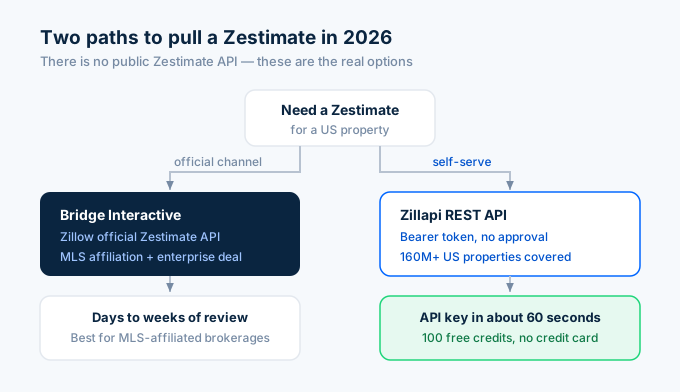
Yes and no. Zillow’s official Zestimate API exists but requires enterprise approval through Bridge Interactive and is restricted to MLS-affiliated partners. For the vast majority of developers, the practical answer is third-party REST wrappers. Zillapi returns Zestimates for 160M+ U.S. properties through a standard REST API with bearer token auth, no approval process, and 100 free credits at signup.
Here’s the confusing part. If you search for “Zestimate API” on Zillow’s developer portal, you’ll find a page at zillowgroup.com/developers/api/zestimate describing the API. It covers ~100 million properties. It sounds exactly like what you want.
But click through and you land on Bridge Interactive, where you need MLS affiliation and an application that takes days to weeks. Most developers bounce here.
The old approach was different. Before September 2021, Zillow offered a free GetZestimate endpoint through the ZWSID API. Any developer could pull a Zestimate with a simple API key. That endpoint died with the rest of the public API.
In 2026, two paths get you Zestimates:
Path 1: Bridge Interactive. Zillow’s official channel. Requires MLS affiliation, enterprise agreement, weeks of approval. Data access varies by partnership terms. Best for MLS-affiliated brokerages building IDX platforms.
Path 2: Third-party REST APIs. Independent services like Zillapi that return the same Zestimate data through self-serve REST endpoints. Signup in 60 seconds, no credit card, API key immediately. Best for everyone else.
How do I pull a Zestimate with code?
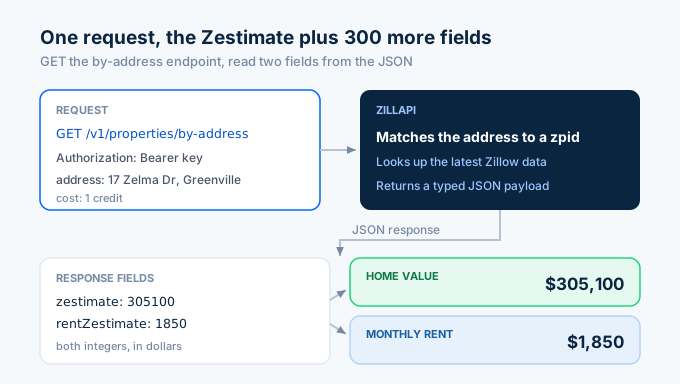
One API call. That’s it. Here’s the Zestimate for any U.S. property:
curl "https://api.zillapi.com/v1/properties/by-address" \ -H "Authorization: Bearer $ZILLAPI_KEY" \ --data-urlencode "address=1600 Pennsylvania Ave NW, Washington DC 20500" \ -GThe response includes the Zestimate as a typed integer:
{ "data": { "zpid": "{zpid}", "zestimate": 305100, "rentZestimate": 1850, "price": 295000, "homeStatus": "NOT_LISTED", "bedrooms": 3, "bathrooms": 2, "livingArea": 1432 }}zestimate is the home value estimate in dollars. rentZestimate is the monthly rent estimate in dollars. Both update regularly and match what Zillow.com shows on the property page.
In Python, pulling a Zestimate is 6 lines:
import requests, os
r = requests.get(    "https://api.zillapi.com/v1/properties/by-address",    params={"address": "1600 Pennsylvania Ave NW, Washington DC 20500"},    headers={"Authorization": f"Bearer {os.environ['ZILLAPI_KEY']}"},)zestimate = r.json()["data"]["zestimate"]print(f"Zestimate: ${zestimate:,}")  # Zestimate: $305,100
In JavaScript:
const res = await fetch( `https://api.zillapi.com/v1/properties/by-address?address=${encodeURIComponent("1600 Pennsylvania Ave NW, Washington DC 20500")}`, { headers: { Authorization: `Bearer ${process.env.ZILLAPI_KEY}` } });const { data } = await res.json();console.log(`Zestimate: $${data.zestimate.toLocaleString()}`);Each call costs 1 credit and returns the Zestimate plus 300+ other fields. If you only want the Zestimate, use the fields parameter to trim the response:
?fields=zestimate,rentZestimate,addressThat cuts the response from ~3,000 tokens to about 50.
How accurate is the Zestimate?
This is the question that matters for production applications. If you’re showing Zestimates to users or using them for investment calculations, you need to know the error margin.
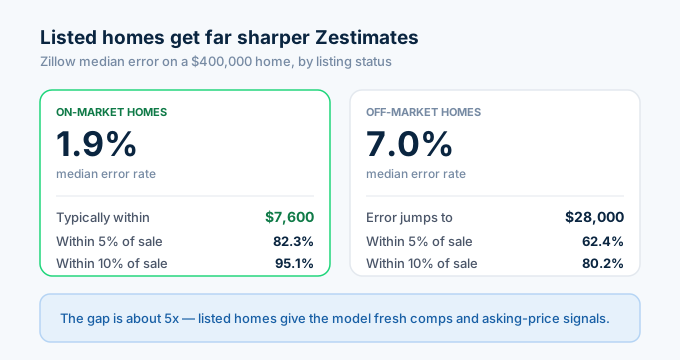
Zillow publishes their own accuracy metrics on zillow.com/zestimate. The current numbers:
| Metric | On-market homes | Off-market homes |
|---|---|---|
| Median error rate | 1.9% | 7.0% |
| Within 5% of sale price | 82.3% | 62.4% |
| Within 10% of sale price | 95.1% | 80.2% |
In dollar terms on a $400,000 home:
- On-market: the Zestimate is typically within $7,600 of the final sale price
- Off-market: the error jumps to roughly $28,000
That 5x accuracy gap between listed and unlisted homes is the most important thing to understand about Zestimates. When a home is actively listed, Zillow has fresh comparable data and asking price signals. When it’s off-market, the model relies on older data and public records.
Three things affect Zestimate accuracy the most.
The first is market density. Urban areas with lots of comparable sales produce better Zestimates than rural areas with few transactions. A Zestimate for a condo in Manhattan is more reliable than one for a farmhouse in Montana.
The second is home uniqueness. Standard tract homes with similar neighbors get accurate Zestimates. Custom homes, mixed-use properties, and anything unusual throws the model off.
The third is data recency. Areas where tax assessors update frequently and sales records flow quickly into public databases produce better Zestimates. Some counties lag months behind.
What’s the difference between Zestimate and other home valuations?
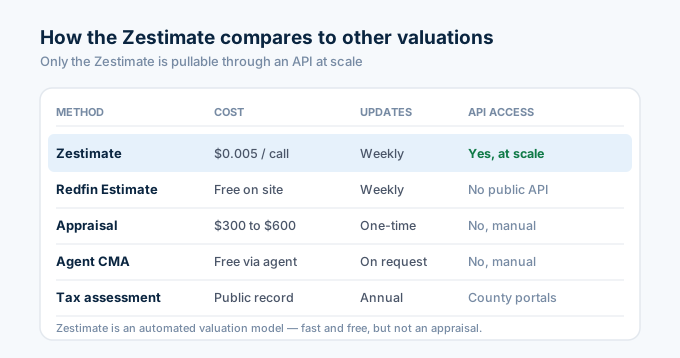
Developers building real estate tools often need to explain Zestimates to their users. Here’s how they compare to other valuation methods:
| Valuation type | Source | Cost | Update frequency | Best for |
|---|---|---|---|---|
| Zestimate | Zillow AVM | Free via API ($0.005/call) | Weekly+ | Quick estimates, portfolio screening |
| Redfin Estimate | Redfin AVM | Not available via API | Weekly+ | Consumer comparison |
| Appraisal | Licensed appraiser | $300-600 per property | One-time | Mortgage lending, legal proceedings |
| CMA | Real estate agent | Free (via agent relationship) | On request | Listing price decisions |
| Tax assessment | County assessor | Public record | Annual | Property tax basis |
Zestimates are the only AVM estimate you can pull programmatically at scale without a brokerage license or appraiser certification. That’s why they show up in so many developer projects: proptech tools, investment calculators, portfolio dashboards, and AI agents.
What can you build with the Zestimate API?
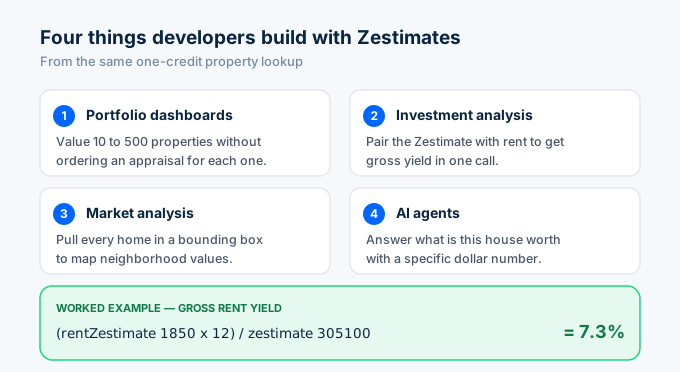
I see developers use Zestimates for four main things.
The most common is portfolio valuation dashboards. Real estate investors with 10 to 500 properties need current valuations without ordering appraisals for each one. Pull Zestimates for every property in a portfolio, sum them, and track total value over time. One API call per property, refreshed monthly.
Next is investment analysis. Combine the Zestimate with the rent Zestimate to calculate gross rent yield in a single API call. (rentZestimate * 12) / zestimate gives you the cap rate proxy. For the example property above: (1850 * 12) / 305100 = 7.3%.
Then there’s comparative market analysis. Pull Zestimates for every property in a neighborhood to build a heat map of home values. The search endpoint returns multiple properties in a bounding box, each with its Zestimate.
And increasingly, AI agents and chatbots. When a user asks “what’s this house worth?” your agent calls the API, reads the Zestimate field, and answers with a specific number. The AI agent guide shows how to wire this up with Claude, ChatGPT, or Cursor.
How much does Zestimate API access cost?
The Zestimate is one field in a larger property response. You don’t pay separately for it. Every Zillapi API call returns the Zestimate along with 300+ other fields at the same price.
| Plan | Credits | Cost | Per Zestimate |
|---|---|---|---|
| Free | 100 (one-time) | $0 | $0.00 |
| Monthly | 1,000/month | $5/mo | $0.005 |
| Annual | 12,000/year | $54/yr | $0.0045 |
Top-up credits are available on Monthly ($4 per 1,000) and Annual ($3 per 1,000). The free tier does not support top-ups. No credit card needed for the free tier. That is 100 Zestimates for $0.
For context, a professional appraisal costs $300 to $600 per property. Pulling 1,000 Zestimates through Zillapi costs $5. That’s a 60,000x cost reduction for a fast, automated estimate versus a manual one.
Obviously a Zestimate isn’t an appraisal. The accuracy section above makes the trade-offs clear. But for screening, portfolio tracking, and quick estimates, the economics are hard to argue with.
Get your first Zestimate in 60 seconds
Go to zillapi.com. Sign up with your email. Get 100 free credits.
Then pull a Zestimate for your own address. Compare it to what Zillow.com shows. If it matches and the field coverage works for your use case, you’ve found your Zestimate API.
For a deeper technical walkthrough with code examples, edge cases, and batch processing, check out our full Zestimate guide.
Frequently asked questions
Is there a Zestimate API I can use in 2026?
Not from Zillow directly for most developers. Zillow’s official Zestimate API through Bridge Interactive requires enterprise approval and MLS affiliation. Third-party REST APIs like Zillapi return Zestimates for any U.S. property with no approval process. You sign up with email, get 100 free API credits, and pull Zestimates immediately. Each call returns the zestimate field as an integer in dollars.
How accurate is the Zestimate in 2026?
Zillow reports a nationwide median error rate of 1.9% for on-market homes and 7.0% for off-market homes. On a $400,000 home that is listed for sale, the Zestimate is typically within $7,600 of the final sale price. For off-market homes the error jumps to roughly $28,000. Accuracy varies by market, with dense urban areas performing better than rural ones.
How do I get a Zestimate with Python?
Use Python’s requests library with a Zillapi API key. Call the /v1/properties/by-address endpoint with an address parameter and read response.json()["data"]["zestimate"]. The value comes back as an integer in dollars. The rent Zestimate is available in the rentZestimate field. Both work for any of the 160M+ U.S. properties in the database.
What is the difference between Zestimate and appraised value?
A Zestimate is Zillow’s automated valuation model (AVM) estimate based on public data, tax records, and comparable sales. An appraised value is a licensed appraiser’s opinion after a physical inspection. Zestimates update regularly without human involvement. Appraisals are point-in-time assessments ordered by lenders. Zestimates are free to access. Appraisals cost $300 to $600 per property.
Can I get Zestimates in bulk through an API?
Yes. Loop through addresses and call the Zillapi /v1/properties/by-address endpoint for each one. Each call costs 1 credit and returns the Zestimate along with 300+ other fields. At the 200 requests per minute rate limit, you can pull 12,000 Zestimates per hour. For larger batches, the webhooks endpoint supports async job processing.
Does the Zestimate API return rent estimates too?
Yes. Every Zillapi property response includes both the zestimate field (home value estimate) and the rentZestimate field (monthly rent estimate). Both are integers in dollars. This makes it possible to calculate gross rent yield in a single API call by dividing annual rent by the Zestimate. No separate endpoint or extra credit cost required.